

Somewhere this week, a business will look at its rising costs, increase its sales target and ask marketing to bring in more leads.
The marketing budget may stay the same. Prices may have changed. Customers may be taking longer to decide. The sales team may already have enquiries it cannot convert.
Yet the instruction will be to generate more.
The Autumn Budget, delivered on 28 October 2026, gives businesses several reasons to examine that conversation more carefully. Changes to household finances, employment costs and investment will affect what organisations can afford, what customers prioritise and how confidently either will spend.
Marketing plans contain assumptions about all of those things. We assume a particular customer will buy, at a particular price, within a particular period. We assume the business can serve them profitably. We assume the activity that worked last year will continue to produce a similar result.
When the commercial conditions change, those assumptions need checking.
At The Insights Loop, I look at how customer evidence, market conditions and business performance fit together. The Budget provides useful context for that work. The decisions still need to be grounded in what is happening within the individual business.
What does Autumn Budget 2026 mean for marketing?
The Budget brings a combination of cost pressures, targeted support and potential investment opportunities. Their relevance will depend on what a business sells, who buys it and when the measures take effect.
The Budget documents report the following Office for Budget Responsibility forecasts. These are forecasts, rather than assured outcomes.
| Measure | Period | Forecast growth |
|---|---|---|
| Gross domestic product | 2026 | 1.2% |
| Gross domestic product | 2027 | 1.0% |
| Household consumption | 2027 | 0.6% |
| Business investment | 2027 | −0.5% |
For a company planning substantial sales growth, those figures are a reason to examine where that growth is expected to come from.
Will existing customers buy more often? Will the business win market share? Is a new product opening another source of demand? Will higher prices increase revenue while reducing the number of purchases?
Each route requires different work. A target that depends on winning customers from competitors needs a credible reason for those customers to switch. A target based on repeat purchases requires evidence that people have both a reason and an opportunity to buy again.
A national growth forecast cannot make those decisions for you. It can prompt a more useful examination of the plan.
Household support does not tell us what customers will buy
The Budget includes support with energy costs and higher statutory minimum wages. From April 2027, the National Living Wage for workers aged 21 and over will rise by 3.9% to £13.21 an hour.
For businesses selling to households, that raises questions about future spending.
Some customers may use additional income or lower bills to make purchases they have postponed. Others may repay debt, rebuild savings or cover costs that have already increased.
Even within one household, spending decisions can move in different directions. Someone might continue buying small treats while delaying furniture, replace a subscription with a cheaper alternative or pay more for something they expect to last longer.
Calling that person “price-conscious” does little to explain which offer they will choose.
Businesses need to examine what customers are protecting, reducing, postponing and replacing. Purchase frequency, basket composition, cancellations, enquiries and customer conversations can help reveal those decisions.
A fall in sales could reflect reduced purchasing power. It could also mean customers no longer see sufficient value in the offer. Those explanations deserve different responses.
Higher costs change what a worthwhile sale looks like
As employment and other costs change, businesses need to revisit the economics behind their sales targets.
Marketing teams should understand which customers, products and services leave enough contribution to support the business after the variable costs of serving them.
Consider an illustrative company making £100,000 in sales, with £30,000 remaining after variable costs. If those costs rise by £5,000 and everything else stays the same, contribution falls to £25,000.
At the new 25% contribution margin, the business would need another £20,000 in sales to recover that £5,000. That assumes the additional sales have the same economics and require no extra fixed costs.
| Measure | Before | After cost increase |
|---|---|---|
| Sales | £100,000 | £100,000 |
| Variable costs | £70,000 | £75,000 |
| Contribution | £30,000 | £25,000 |
| Contribution margin | 30% | 25% |
The request for more revenue can therefore involve a considerable increase in customer acquisition, delivery and working capital.
Before commissioning another campaign, finance, sales and marketing should agree what kind of business they want to attract.
A customer who buys repeatedly, pays reliably and needs relatively little support may be more commercially valuable than a larger account that requires substantial discounts and constant intervention.
Those differences should influence targeting, offers and the attention given to existing customers.
Discounting can make a revenue problem more expensive
When customers hesitate, a promotion can feel like the quickest available response.
The calculation deserves attention before the offer goes live.
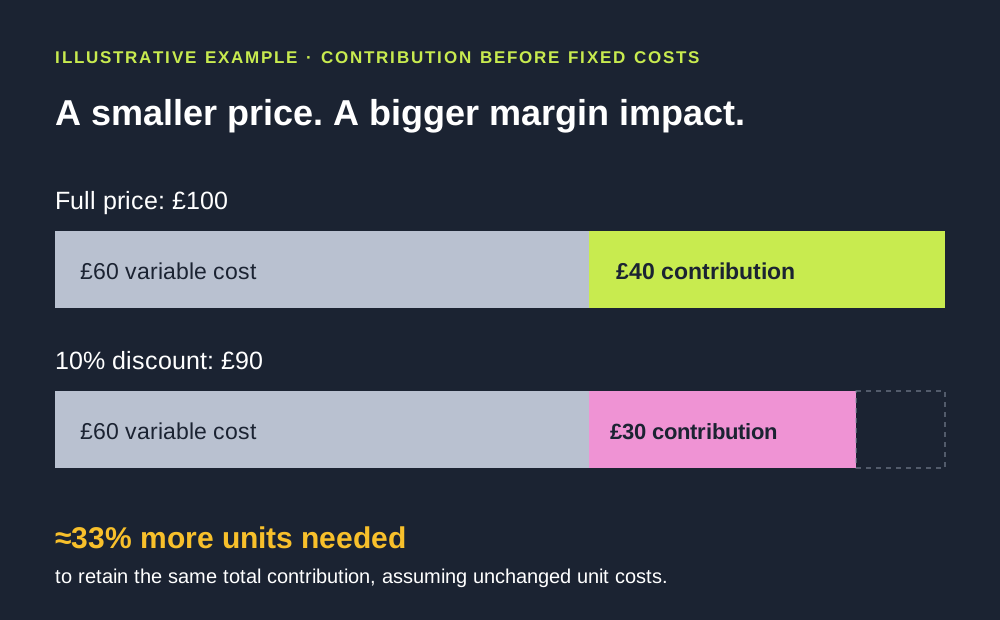
Suppose a product sells for £100 and has a £60 variable cost. It contributes £40 before fixed costs. A 10% discount reduces that contribution to £30, assuming the variable cost remains unchanged.
The business would need to sell approximately 33% more units to generate the same total contribution. Additional advertising, fulfilment or returns would affect the result further.
A promotion may still be appropriate. It could clear ageing stock, encourage trial or support a specific cash-flow objective.
But a lower price may do little for a customer who is worried about quality, delivery or whether the product will solve their problem.
Before discounting, examine the objections. Customer questions, lost-sale reasons and abandoned journeys may reveal that people need clearer information or stronger evidence before they will commit.
B2B buyers will need help making the internal case
The Budget provides additional capital for the National Wealth Fund and British Business Bank, alongside measures intended to support business growth and strategic industries.
For suppliers, that creates potential opportunities. It does not establish which organisations are ready to purchase.
A prospective customer may still need to secure finance, approve a project, appoint a team or complete procurement. Marketing and sales need to understand where the organisation is in that process.
This should influence the information they provide.
Someone evaluating a supplier may have to justify the purchase to a finance director or board. They may need to explain the implementation effort, what their team must contribute, the likely disruption and the consequences of delaying.
A claim that your service “saves time” leaves much of that work to the buyer.
Relevant examples, clear scope and transparent assumptions make the decision easier to assess. Sales teams need material that helps them discuss those issues with the people involved.
For some businesses, improving that evidence may do more for conversion than increasing the number of enquiries.
Your most valuable audience may have changed
A changing economy can expose how little a broad customer description tells us.
“SMEs”, “manufacturers” and “homeowners” each contain people and organisations facing very different circumstances.
One manufacturer may have secured a contract and need additional capacity. Another may be reducing expenditure. A third may be replacing a supplier without increasing its overall budget.
Their buying triggers, objections and timescales will differ.
Businesses should examine customer groups according to need, purchasing capacity, buying behaviour and commercial value. Which have a reason to act now? Which convert reliably? Which stay? Which are expensive to acquire or serve?
Existing sales and customer records can help, particularly when combined with conversations and external market evidence.
The result may challenge an established priority. A highly visible audience may contribute less than a smaller group that buys consistently and responds well to the offer.
Marketing resources should reflect those findings.
Follow the enquiry before blaming the economy
Slower sales are often attributed to economic conditions before a business has examined its own customer journey.
The economy may be contributing. It may also be exposing weaknesses that were easier to overlook when demand was stronger.
Enquiries could be reaching the wrong person. Quotations might take too long. Advertising may be attracting customers whose budgets do not match the offer. The website could be setting expectations that the sales conversation cannot support.
Increasing activity can add cost without resolving any of those problems.
Follow a sample of enquiries from first contact to purchase or loss. Examine what people asked, what they received and where progress stopped. Compare different customer groups and routes into the business.
Sometimes the evidence is difficult to assemble because finance, sales and marketing each report a different version of performance.
That is the purpose of The Insights Loop’s business intelligence and strategic decision support: reconciling fragmented information, examining assumptions and establishing what the evidence supports before a major decision is made.
Related reading: why your cheapest marketing leads could be costing you the most.
Marketing expenditure needs measures that support decisions
A low cost per lead can conceal expensive customer acquisition if few enquiries become paying customers.
Reported advertising returns can also look healthy while discounts, returns and fulfilment costs reduce what the business keeps.
At the same time, some marketing work influences future demand and cannot reasonably be judged on immediate sales alone.
The measure should reflect the intended job and timescale.
For an established acquisition campaign, I would examine conversion into customers and the contribution they generate. For activity intended to develop a future market, I would agree milestones that test whether the intended audience is becoming more aware, engaged and commercially interested.
A useful review should lead to a decision: continue, change, investigate, expand or stop.
When money is under scrutiny, reporting needs to help people allocate it.
AI investment should begin with a defined business problem
The Budget includes investment in AI capability, security and adoption.
Businesses considering their own adoption need to establish which work could become more reliable, useful or efficient.
Content production is an obvious application. But publishing more frequently will not resolve confused positioning or an offer customers struggle to understand.
There may be greater value in research that takes too long, inconsistent sales preparation or reports that consume days of staff time before anyone interprets them.
Start by mapping the workflow. What information goes in? Which rules apply? Where is judgement required? What would an acceptable result look like, and who will check it?
Those questions inform The Insights Loop’s AI business systems, which are built around defined workflows, knowledge and decision rules.
The business case should account for review, corrections and maintenance alongside any time saved. It should also establish how the released capacity will be used.
Welsh businesses have additional skills support to consider
For employers in Wales, existing support may help develop the capabilities needed to respond to these commercial pressures.
The Welsh Government’s Flexible Skills Programme offers a standard contribution of 50% towards approved training costs, with a maximum contribution of £50,000 per application. Funding is discretionary and subject to eligibility and approval. Current operational guidance requires supported training to be completed by the end of March 2027.
This is existing Welsh support, rather than a new Autumn Budget announcement.
Business Wales also identifies an enhanced 75% contribution towards eligible training through its refreshed AI Skills Pilot, scheduled to run until the end of March 2027. The published requirements specify training at Level 2 or above, assigned by a regulated awarding body within the Welsh qualifications framework.
That support concerns qualifying training. It should not be assumed to cover AI software purchases, consultancy or bespoke system development.
Employers should confirm the proposed training’s eligibility and obtain approval before starting. CPD certification alone does not establish eligibility for either scheme.
Funding can reduce the cost of developing staff, but the training still needs to address a genuine gap. The business should be able to explain what someone will do better afterwards and how that capability will be used.
Give the person doing the marketing enough commercial understanding
Many decisions prompted by the Budget will reach marketing as requests for activity.
Generate more leads. Promote another service. Improve conversion. Launch a campaign.
The person receiving that request needs enough understanding to establish whether the proposed work can deliver the intended result.
They need to know who the customer is, why they buy, what the business earns and where the sales process succeeds or fails. Channel skills then help them put an informed decision into practice.
This is how I approach The Insights Loop’s Digital Marketing & Implementation Programme. Participants begin with a business diagnostic and priorities plan, then develop practical marketing work with assessed feedback. The live route adds strategic support and accountability as the work progresses.
For eligible Welsh employers, a contribution towards approved programme costs may be available through the Flexible Skills Programme, subject to the proposed training and application being accepted.
The commercial benefit should extend beyond completing lessons. The participant should become better equipped to make decisions, explain their reasoning and implement work relevant to the organisation.
What should businesses review after the Budget?
I would begin with the assumptions behind the next year’s plan.
- Establish the financial requirement. Be clear about the additional revenue, contribution or cash needed, and by when.
- Examine customer behaviour. Look for changes in purchase frequency, order value, product mix, decision time and reasons for declining.
- Recalculate the economics. Assess how relevant cost changes affect pricing, contribution and the volume required to meet the target.
- Revisit priority audiences. Identify where a buying need, purchasing capacity and commercially viable delivery overlap.
- Follow enquiries through to outcomes. Establish whether acquisition, follow-up, the offer or delivery is limiting performance.
- Assess the capability to respond. Consider whether the business needs better evidence, staff development, practical implementation or a more effective workflow.
Then choose a manageable number of interventions, each with an owner, a clear purpose and a review point.
Where does your business need a clearer answer?
The Budget will influence the conditions in which businesses sell. Customer priorities, costs and investment decisions may change at different speeds.
The work now is to establish how those changes affect your customers and your business, then decide what deserves attention.
That could mean revisiting a market, understanding why enquiries are not converting, developing the person responsible for marketing or improving how commercial information is interpreted.
If the Budget has prompted you to question your growth plans, marketing expenditure or the capability within your team, discuss your business priorities with The Insights Loop. We can establish where the problem sits and which support would be useful.